Skip to content

Chapter Three

Asset Protection


Raise the Shield Before You Need It

Your wealth can't be protected in the moment it's threatened. Think of it like buying homeowner's insurance while your house is already burning. By the time a lawsuit is filed, a business partner turns on you, or a personal guarantee gets called in, the window to act has already closed.

Asset protection doesn't work on demand. It works because you built it long before you needed it, just as a helmet only saves you if it's already on your head.

Wealth Castle-1
Building Your Wealth Castle
The Layers of Protection for Entrepreneurs
 

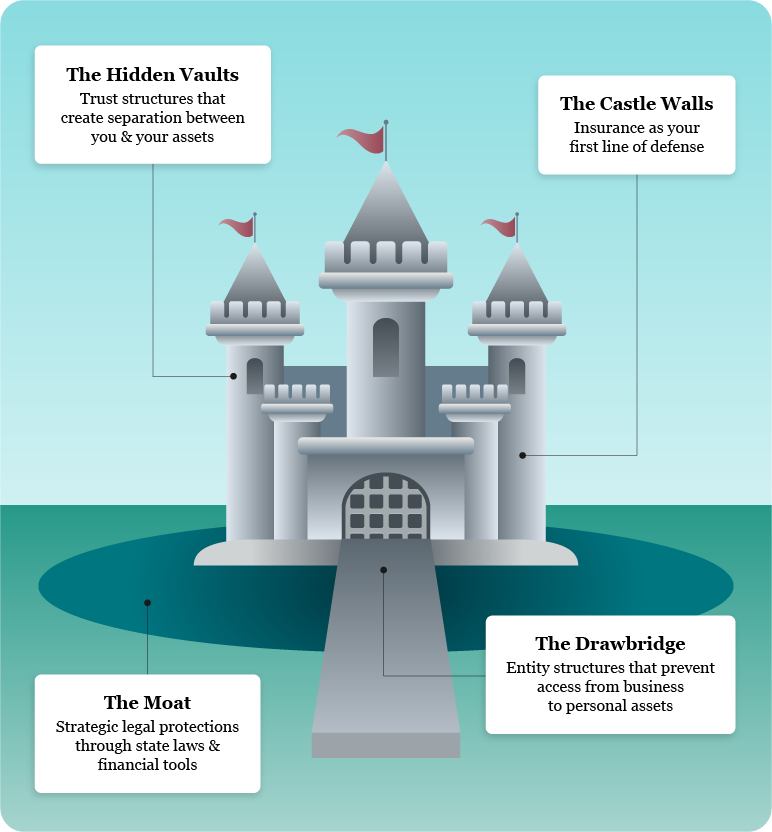
The most successful entrepreneurs we've worked with don't think about asset protection as a checklist. They think about it like a medieval castle. Every layer is intentional. Every barrier serves a purpose. And together, they create a defense that modern threats simply can't breach.

Nathan Rothschild built one of history's greatest banking fortunes and understood something many entrepreneurs learn too late: the boldness that creates wealth and the discipline that protects it are completely different skills. You've already proven you have the first. This is about developing the second.

Your wealth castle has four layers, each doing its own job. The moat — foundational legal protections at the state and federal level — is your first line of defense. The castle walls are your insurance policies, standing between you and liability. The drawbridge is your legal entity structure, keeping personal and business assets firmly separated. And deep inside, your hidden vaults — asset protection trusts — guard what matters most.

The Fractional Family Office® brings all four layers together, coordinating your protection so you can stay focused on what you do best: growing.
“It requires a great deal of boldness and a great deal of caution to make a great fortune, and when you have got it, it requires ten times as much wit to keep it.”
 
Nathan Mayer Rothschild

Your Four Layers of Protection


Moat Icon 2
 The Moat

Insurance as your first line of defense against unforeseen losses

Castle Walls Icon 2
 The Castle Walls

Strategic legal protections through state laws & financial tools

Drawbridge Icon 2
 The Drawbridge

Entity structures controlling access between business & personal wealth

Hidden Vaults Icon 2
The Hidden Vaults

Trust structures that create separation between you & your assets

JDBRIT~1
The Moat
Your Legal Foundation


The moat surrounding your castle represents the baseline legal protections available to every entrepreneur. Built from state and federal laws, it is your first line of defense. It creates distance between your assets and potential threats like creditors or lawsuits.

One of the most powerful features is your home. Depending on where you live, homestead laws can protect a significant portion of your home’s value. Knowing how these rules work is a strategic move.


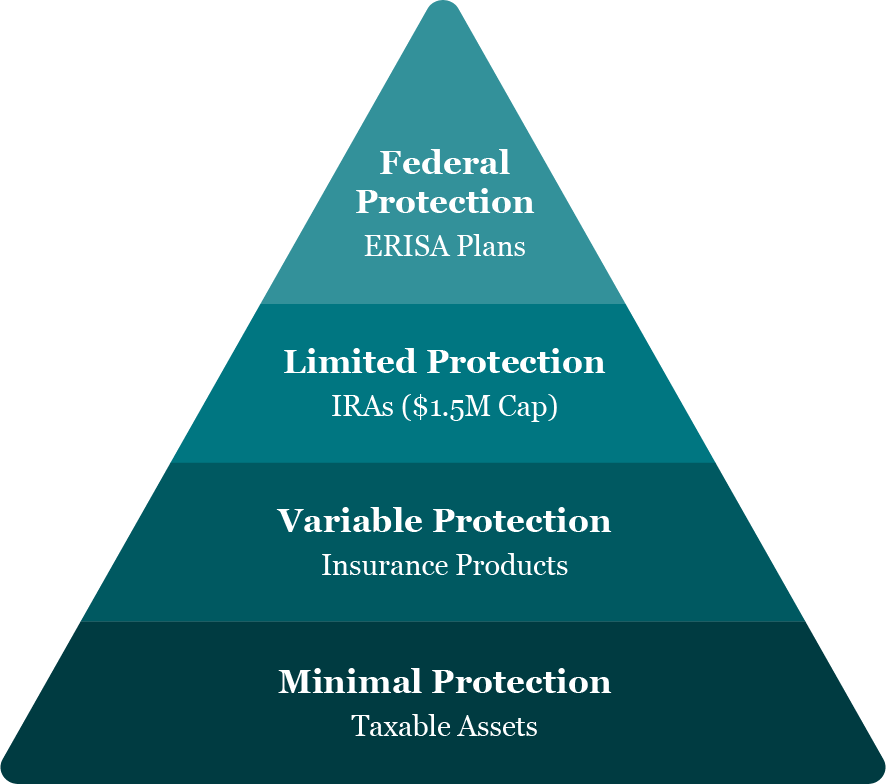
Protected Assets Under Law Pyramid
Protected Assets Under Law
Hierarchy of Protection for Entrepreneurs
 

Not all assets are equally exposed. Some come with built-in armor. Retirement accounts like 401(k)s and IRAs often receive strong protection, with employer plans leading the pack. Life insurance and annuities can also offer protection, depending on the state and structure.

But don’t chase these tools just for safety, especially when high commissions are involved. The key is understanding which assets are naturally shielded, so you can build a smarter, more resilient financial foundation.


Castle Walls 2
The Castle Walls
Strategic Insurance Coverage


Many entrepreneurs, especially in today’s digital-first economy, naturally prioritize growth, scale, and new opportunities. But building wealth is only part of the equation; preserving it requires just as much intention. Without the right protections in place, success can remain exposed to unnecessary risk.

Think of insurance as the walls around your financial “castle” that are designed to absorb shocks, protect what you’ve built, and provide stability. The key is creating coverage that’s strong enough to withstand uncertainty, while still being efficient and sustainable over time.

Personal Property & Casualty Insurance
 

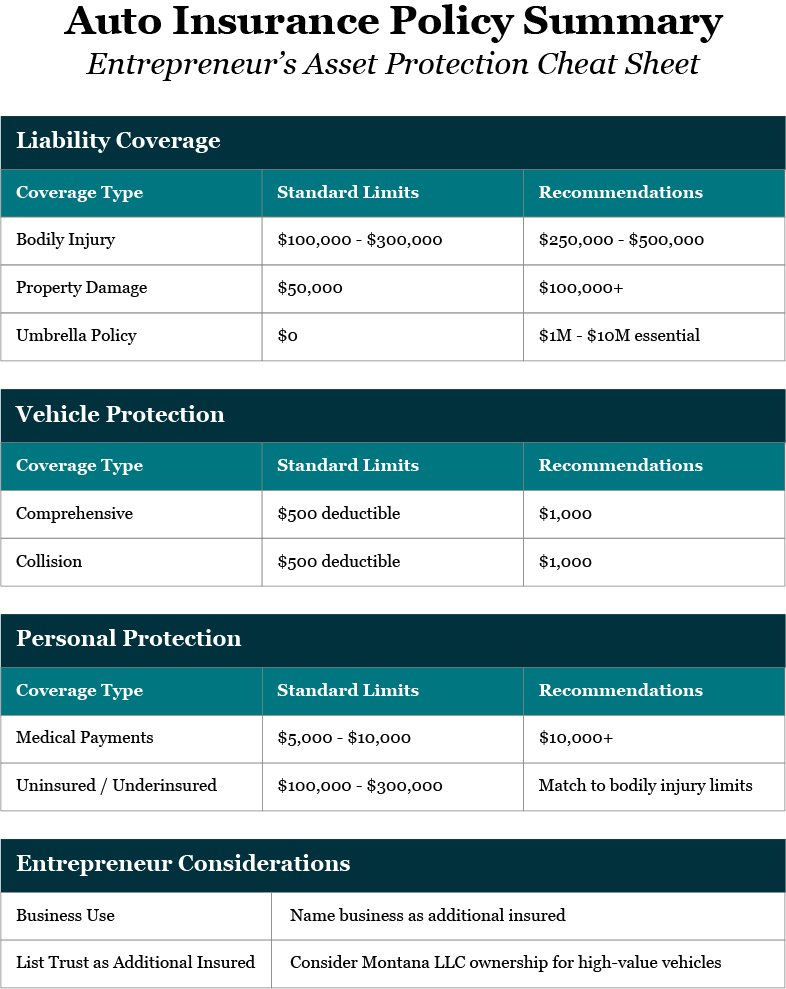
Many entrepreneurs wouldn't dream of leaving their business exposed, yet countless do exactly that with their personal insurance. Using a personal vehicle for business purposes without the right coverage can void your policy the moment you need it most. Smart vehicle coverage means high liability limits, uninsured motorist protection, and a clear distinction between personal and commercial use.

One move that many overlook is raising your deductible. If you wouldn't file a claim for $500, why pay premiums to cover it? Insurance exists for the risks you can't absorb. Increasing your deductible lowers your annual cost without sacrificing real protection.

The costly blind spot is college-age dependents. Consider a couple who built a seven-figure business over 15 years, then removed their college freshman daughter from their auto policy since she didn't have a car on campus. Three months later, she drove a friend's car, was involved in an accident, and the family faced a $750,000 lawsuit. They settled for $350,000 out of pocket plus $75,000 in legal fees.

The premium savings weren't worth it. If your child is still a dependent, keep them on your policy. The exposure is simply too large to leave unprotected.

The same principle extends to homeowners and umbrella coverage. Insure your home at replacement cost, not market value. List every trust, LLC, vehicle, and property on your umbrella policy — which starts around $300 per year per $1 million in coverage. That's a small price for protection that covers everything from lawsuits to defamation claims.

Auto Insurance Policy

Business Insurance: Protecting Your Enterprise

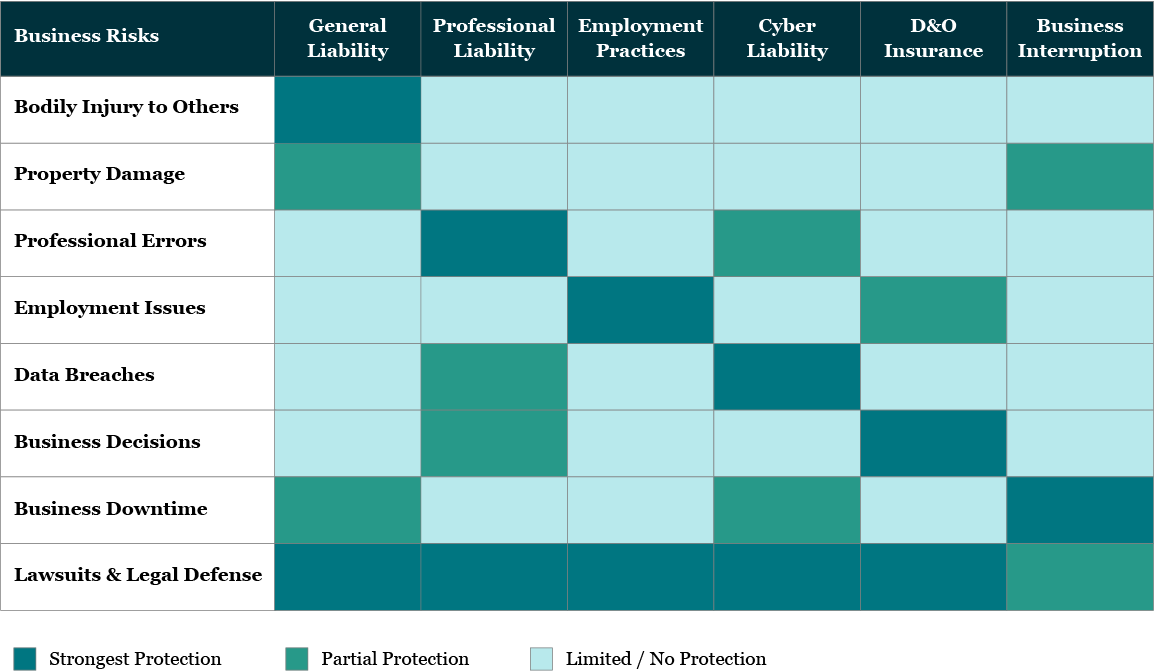
Your business is the engine of your wealth. Make sure it's protected like one. Entrepreneurs consistently underinsure their businesses, and the gaps tend to surface at the worst possible moments. Here's what a properly built business insurance portfolio actually covers:

General Liability
Professional Liability
EPLI
Cyber Liability
D&O Insurance
Commercial Auto 
Commercial Umbrella
Business Insurance: Protection Matrix
Which Policies Protect Against Which Business Risks
 
Business Insurance Protection Matrix 2

Life Insurance Done Right: How Billionaires Do It

Many entrepreneurs have been told they need term or permanent life insurance. The truth is more nuanced and the difference in how you structure it can be worth over a million dollars.

Term Insurance

Permanent Insurance

The typical coverage guideline is 10–15x your annual income. But as an entrepreneur, you also need to account for business obligations, loan guarantees, buy-sell agreements, and key-person coverage. Your coverage needs are almost certainly more complex than a standard formula suggests.

Four Rules for Buying Life Insurance Like the Ultra-Wealthy

  • Work with an independent agent: A captive agent can only sell from one company. An independent agent shops multiple carriers — the same way you'd evaluate multiple vendors for any critical business purchase.
  • Demand competitive underwriting: Insurance companies assess risk differently. Make carriers compete to bid on your policy — the savings can be substantial for the exact same coverage.
  • Insist on a max blend structure: This is critical. Maximum commission blending reduces agent payout and puts cash value back into your policy where it belongs — not in their pocket.
  • Never buy without someone in your corner: Many life insurance salespeople have no legal obligation to act in your best interest. They get paid when you sign, regardless of whether the policy makes sense for you.
Real Case Study:
Same Policy, Better Structure
 

A client was considering a $100,000 annual premium policy for 20 years. The original proposal was structured to maximize the agent's commission — $112,200 in year one alone — leaving $0 in first-year cash value.

We redesigned it with maximum commission blending, cutting the agent commission to $23,032 and putting $79,025 back in the client's pocket in year one alone.

 Commission Reduced
 
$89K
Annual Tax-Free Income
 
$323K
 20-Year Difference
 
$908K
The difference between a well-structured policy and a commission-heavy one isn't hyperbole — it's math. Treat life insurance the way the ultra-wealthy do: as a business decision, not a sales pitch.
The Drawbridge
The Drawbridge
Legal Entity Structures


Think of your business entity structure as a drawbridge between your professional and personal financial worlds, with it only working if you maintain it properly. Entrepreneurs are far more likely to face a lawsuit in business than in their personal lives, and when that happens, plaintiffs' attorneys will immediately try to "pierce the corporate veil" and reach your home, investments, and savings.

Preventing that requires clean corporate governance: separate finances, documented decisions, and proper annual filings. But the bigger legal threat rarely comes from outside. Partner disputes happen five to ten times more frequently than external lawsuits, and a weak operating agreement is the number one reason they turn catastrophic.

We've watched 20-year friendships unravel into months of litigation because an operating agreement had no provisions for unequal capital contributions or a clear buyout process, costing both partners a thriving business, a friendship, and significant money in legal fees. A professionally drafted operating agreement isn't pessimism; it's the same logic behind a prenuptial agreement. You plan for the best and protect against the worst because without clear exit provisions and dispute resolution mechanisms, even the strongest partnerships can collapse under pressure.


Hidden Vaults 1
The Hidden Vaults
Asset Protection Trusts


Beyond the basic protections of entity structures and operating agreements lies a more sophisticated layer of wealth defense: asset protection trusts. If the drawbridge controls who enters your castle, think of these trusts as the hidden vaults deep within its walls — the chambers that only the most determined and resourceful adversaries could ever reach.

This level of protection becomes essential as your success grows because visibility and wealth make you a target. We regularly sit down with entrepreneurs who have spent years building eight-figure fortunes, only to carry a quiet, persistent anxiety that one lawsuit could unravel all of it.

That fear is pattern recognition. In many industries, litigation is a strategic tool used to extract settlements from successful people who have too much to lose to fight back. One founder we worked with had built a company generating over $100 million in annual revenue yet felt paralyzed by the vulnerability of his personal wealth. That vulnerability was actively preventing him from making the bold moves his business needed to reach the next level. Sophisticated trust structures exist precisely to remove that ceiling.


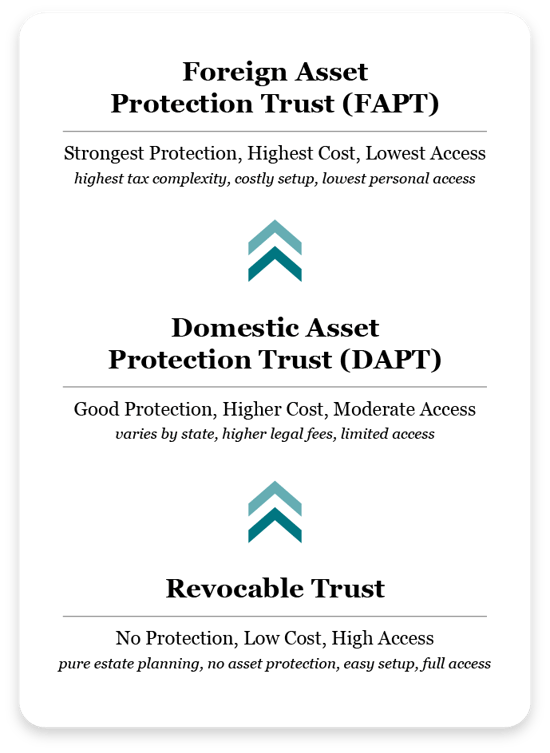
Trust Protection Spectrum
Your Wealth Fortress
Inside Asset Protection Trusts


You've built something significant and that success makes you a target. One lawsuit, one bad actor, one business dispute can threaten everything you've spent years creating. Sophisticated trust structures exist precisely for this moment: to protect what you've earned and free you to keep building without looking over your shoulder.

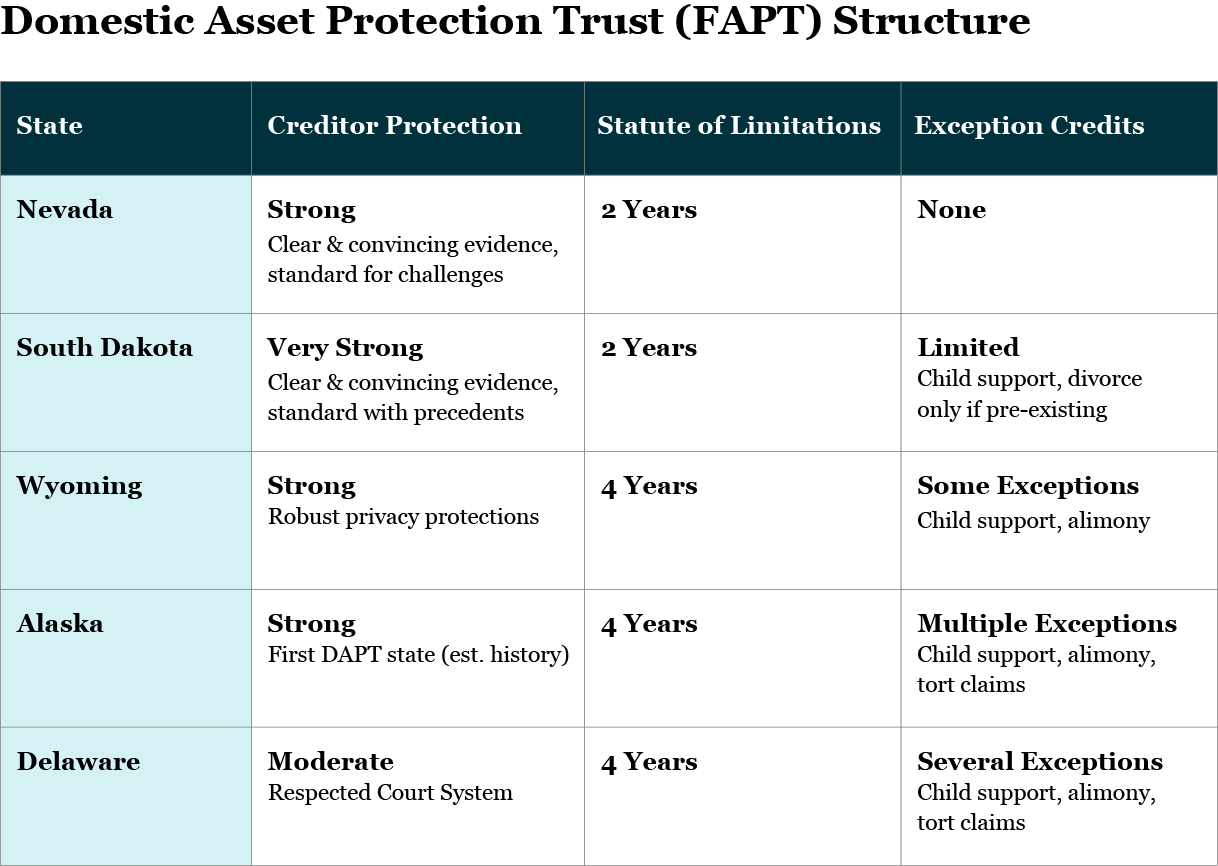
Domestic Asset Protection Trust (DAPT)
A DAPT lets you remain a beneficiary of your own trust while creating a legal wall between you and future creditors. Think of it as a reinforced inner chamber — accessible to you, but heavily secured against outside claims.

Available in favorable states with shorter seasoning periods and robust creditor protections. Ideal for most eight-to-nine figure entrepreneurs who want substantial protection without offshore complexity.

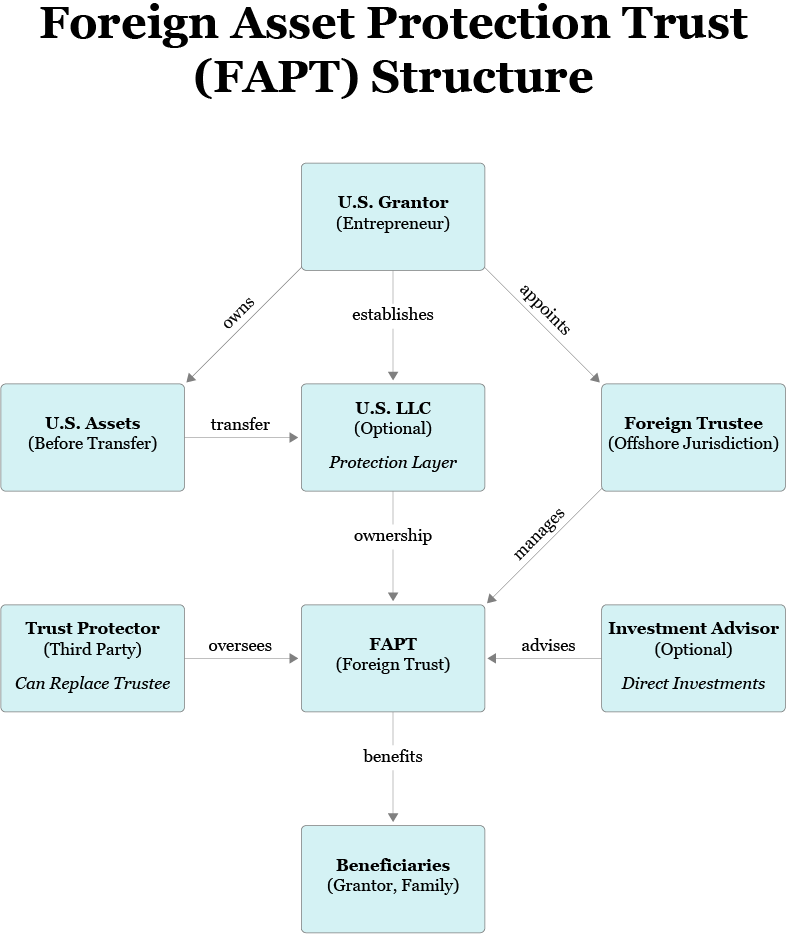
Foreign Asset Protection Trust (FAPT)
For the highest level of protection, FAPTs place assets in jurisdictions that don't recognize U.S. judgments, require creditors to re-litigate locally at great expense, and impose short statutes of limitations.

Significantly more complex to maintain. Requires strict IRS compliance — FBAR, FATCA, and additional filings. The penalties for non-compliance can outweigh the benefits, so this structure demands expert guidance.


DAPT Chart 4
FAPT Structure
Finding the Right Balance
 
Protection without practicality is paralysis. The strongest trust structure fails if it makes your finances unmanageable. The goal is a layered approach: your most critical assets fully shielded, your operating capital still accessible.
11
Match the Structure
 
For many eight-to-nine figure entrepreneurs, a DAPT delivers substantial protection without offshore complexity.
22
Start Before You Need It
 
You can't transfer assets to avoid existing creditors. These structures only work against future, unknown claims.
33
Protection is a Discipline
 
Markets shift, laws evolve, and your wealth grows. Your protection strategy needs to keep pace with all three.


This is where the Fractional Family Office® (FFO) model earns its place. Rather than burdening you with the complexity of coordinating trust administration, compliance monitoring, and strategy updates, a great FFO handles it all so your protection grows alongside your success, without consuming your attention.

Your Castle Won't Build Itself

The entrepreneurs who protect their wealth aren't the ones who waited. Let's build your layers of protection before you need them.

svg-icon Back to Top