


Financial Blind Spots:
When a Second Opinion Is Worth It
What an Independent Review Finds That Siloed Advisors Cannot
What Is a Second Opinion on Your Financial Plan?
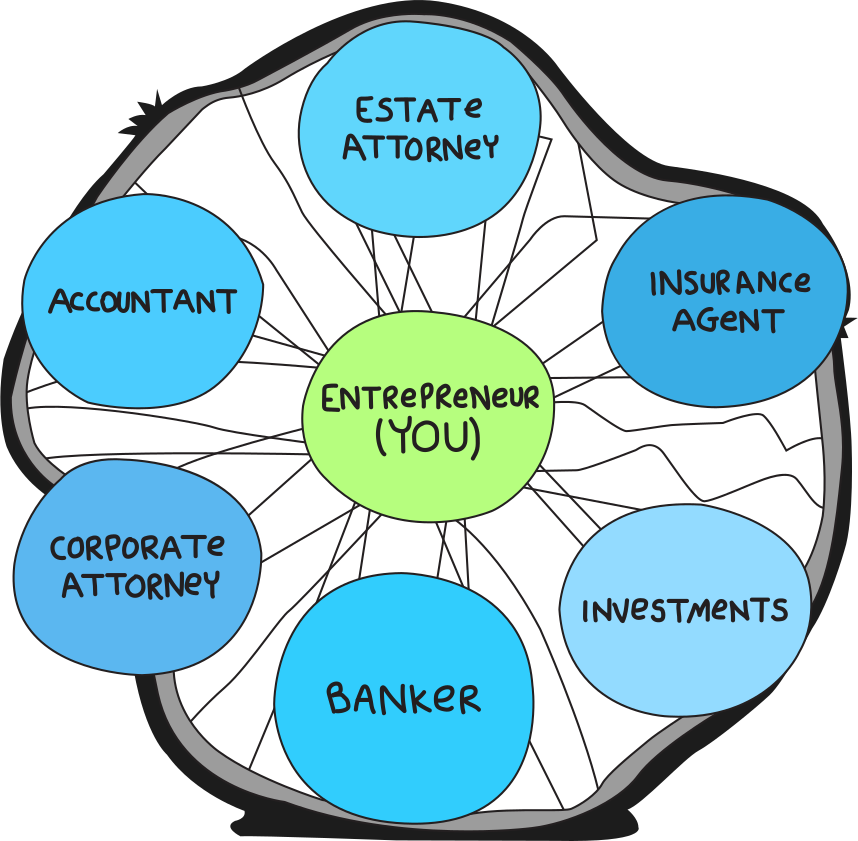
A second opinion is an independent review of your whole financial picture at once - tax, entity structure, investments, insurance, estate documents, and business value - rather than one specialist reviewing one domain. It exists because each of your advisors can be right inside their own scope while nobody is accountable for the seams between them. Those seams are where financial blind spots live: problems no single advisor is wrong about, and no single advisor owns.
The coordination gap is measurable. In the Exit Planning Institute's 2025 State of Owner Readiness Generational Report, only 5% of Baby Boomer owners, 11% of Generation X owners, and 32% of Millennial owners had assembled a full advisory team - an attorney, an accountant, a financial advisor, and a value growth consultant working together. Most successful owners have all four professionals. Far fewer have them in the same conversation, and putting them there is the whole point of what a family office is.

What Are the Most Common Financial Blind Spots?
Four show up more than the rest. None is exotic, and each sits at a handoff between two professionals who are both doing their own job well.
Tax decisions made in separate rooms
An S corporation owner's salary is the clearest case. The IRS requires that an S corporation pay reasonable compensation to a shareholder-employee for services before non-wage distributions are made, weighing factors that include duties, time devoted, comparable pay, and the source of the company's gross receipts. A figure set at formation and never revisited drifts away from all of them. Retirement plan design drifts the same way: for 2026 the elective deferral limit is $24,500, with an $8,000 catch-up at age 50 and over and $11,250 at ages 60 through 63 (IRS Notice 2025-67, announced November 13, 2025). Whether the plan is built to use those limits is rarely anyone's assigned job. Coordinated tax planning for business owners puts both questions on one calendar.
Estate documents that contradict each other
Estate plans go stale quietly, because nothing visibly breaks until the documents are needed. Trust & Will's 2026 Estate Planning Report, a survey of 5,000 U.S. adults conducted January 28 to February 5, 2026, found that 56% of American adults have no estate planning documents at all; among those who do, 14% have never updated them and 13% review them once a decade or less. For owners the exposure is sharper, because a buy-sell agreement, a beneficiary designation, and a will can each be current on their own terms and still contradict one another.
Entity structures left at their founding settings
An entity chosen for the business you had is not automatically right for the business you have. Revenue, headcount, state footprint, and risk profile all move; the structure often does not, because reviewing it sits on no one's list. What that costs is entirely fact-specific - it depends on the entity, the states involved, and how income is actually earned - which is why it belongs in a documented review rather than in a rule of thumb.
Business value nobody is watching
For most owners the business is the largest asset on the balance sheet and the one with no monthly statement. The Exit Planning Institute puts the business at 80% to 90% of a typical owner's net worth, reports that its 2023 National State of Owner Readiness survey found 75% of owners intended to transition within ten years, and states that only 20% to 30% of businesses that go to market actually sell. Owner dependency and customer concentration compound quietly in the meantime, which is the argument for treating business exit planning as a live discipline rather than a one-time event.

What Does a Comprehensive Wealth Assessment Include?
The method matters more than the label. A review that only reads the documents will miss the gaps, because the gaps are between the people, not inside the paperwork.
1. Reading the documents against each other
Three years of tax returns, entity formation and operating documents, the estate plan, insurance declarations pages, investment statements, business financial statements, and the advisor agreements themselves. The work is the cross-reference: the buy-sell against the will, the beneficiary designations against both, the entity against how income is actually earned.
2. Talking to each advisor separately
Each professional is asked what they are handling and what they believe someone else is handling. The gap between those two answers, repeated across a team, is where most blind spots turn up. This step is why a document-only review is not the same exercise.
3. Scoring all eight dimensions together
Every dimension of the wealth wheel is scored on its own, so a weak spoke is visible next to a strong one instead of being averaged away. Scoring them together is the point: the weakest dimension usually sets the outcome regardless of how strong the rest are.
4. A written report you can act from
Findings across every dimension, each gap named with the professional who would close it, and a sequence - because several of these fixes have to happen in a particular order to work. A review that ends in a conversation rather than a document is not something you can hold your team to.
What Has Coordination Been Worth for Dew Wealth Clients?
The figures below are Dew Wealth's own documented client averages. They describe what coordination has been worth across a client population - they are not a projection of what a review would find for any particular reader, and they are not a guarantee.
- Average annual tax savings for 7-figure entrepreneurs: $28,613
- Average annual tax savings for 8- and 9-figure entrepreneurs: $203,769
- Average annual savings from avoided lawsuit and claims exposure: $54,071
- Average annual investment management savings: $18,750
- Average annual business value savings: $16,000
- Figures are 2024 client projections; individual results vary considerably - see the disclosure at the bottom of this page
What sits behind figures like these is coordination rather than any single product or strategy: one team accountable for every dimension at once, which is what the Fractional Family Office® model provides for entrepreneurs whose businesses do not justify a traditional single-family office.
For a closer look at what that team actually does across each dimension, see how how the model works in practice are coordinated in practice.