

What Is the Wealth Wheel?
The Wealth Wheel is a proprietary Dew Wealth framework that organizes professional advisors into a coordinated system working under strategic direction instead of in silos. Jim Dew, CFP and Registered Investment Advisor, developed the Wealth Wheel in "Billionaire Wealth Strategies" (Chapter 6, pages 187-214) to solve what Dew Wealth calls the Financial Flat Tire.
Running a business means building a team of professionals over time: a CPA, an insurance agent, a lawyer, a banker, and an investment advisor. These professionals are like spokes on a wheel. The spokes are not necessarily the most qualified available, and the spokes almost never communicate with each other.
The entrepreneur gets stuck in the middle, trying to coordinate everyone and keep the professionals accountable, but without the time or specific expertise to do so effectively. Each professional operates within a separate regulatory framework: CPAs under IRS Circular 230 and state board licensing, attorneys under state bar rules, insurance agents under state insurance codes and the National Association of Insurance Commissioners (NAIC) model regulations, and investment advisors under the Securities and Exchange Commission (SEC) Investment Advisers Act of 1940 or state registration. No regulation requires these professionals to coordinate with one another.
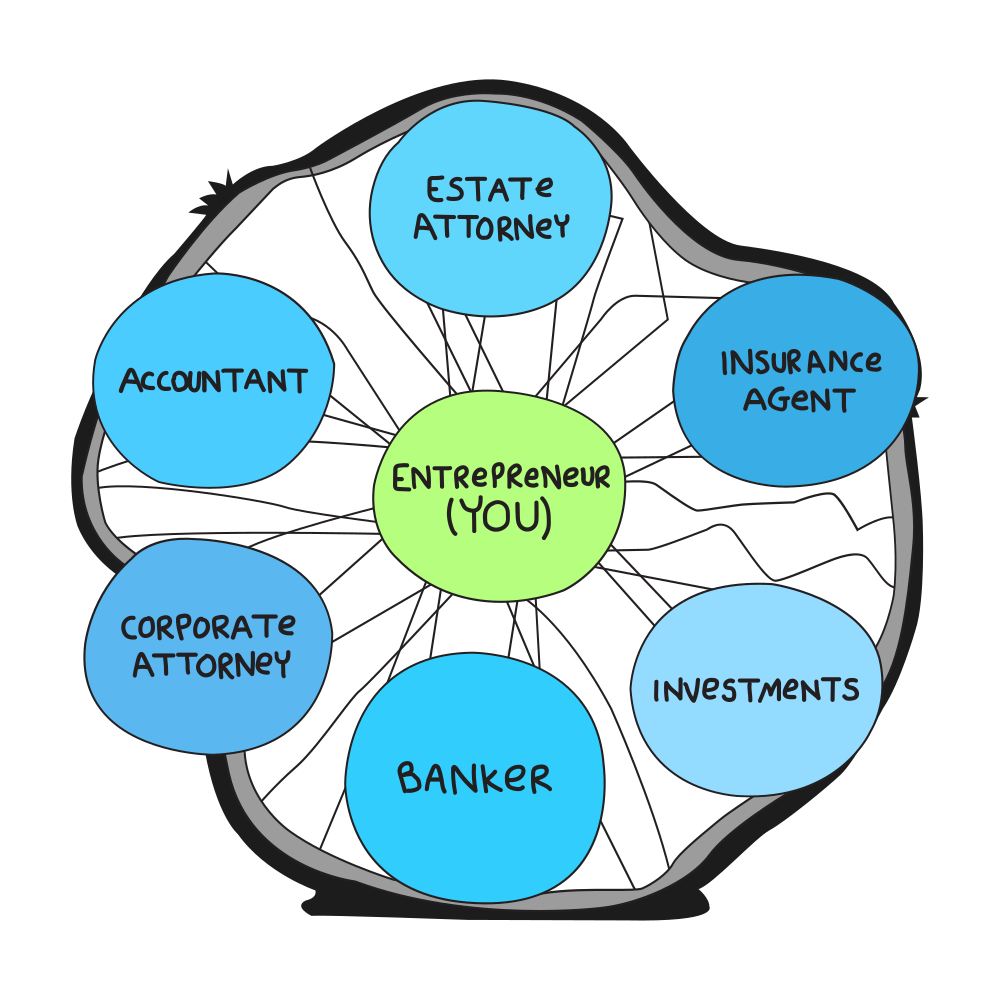
The Wealth Wheel replaces this broken model with a coordinated system where a Linchpin Partner provides strategic direction across all spokes. Research from the Financial Planning Association (FPA) and the Investments and Wealth Institute (IWI) indicates that coordinated advisory teams deliver measurably better outcomes across tax efficiency, risk management, and wealth preservation than siloed advisors. However, coordination requires investment in communication infrastructure and professional fees, and the benefits scale with the complexity of the entrepreneur's financial picture.
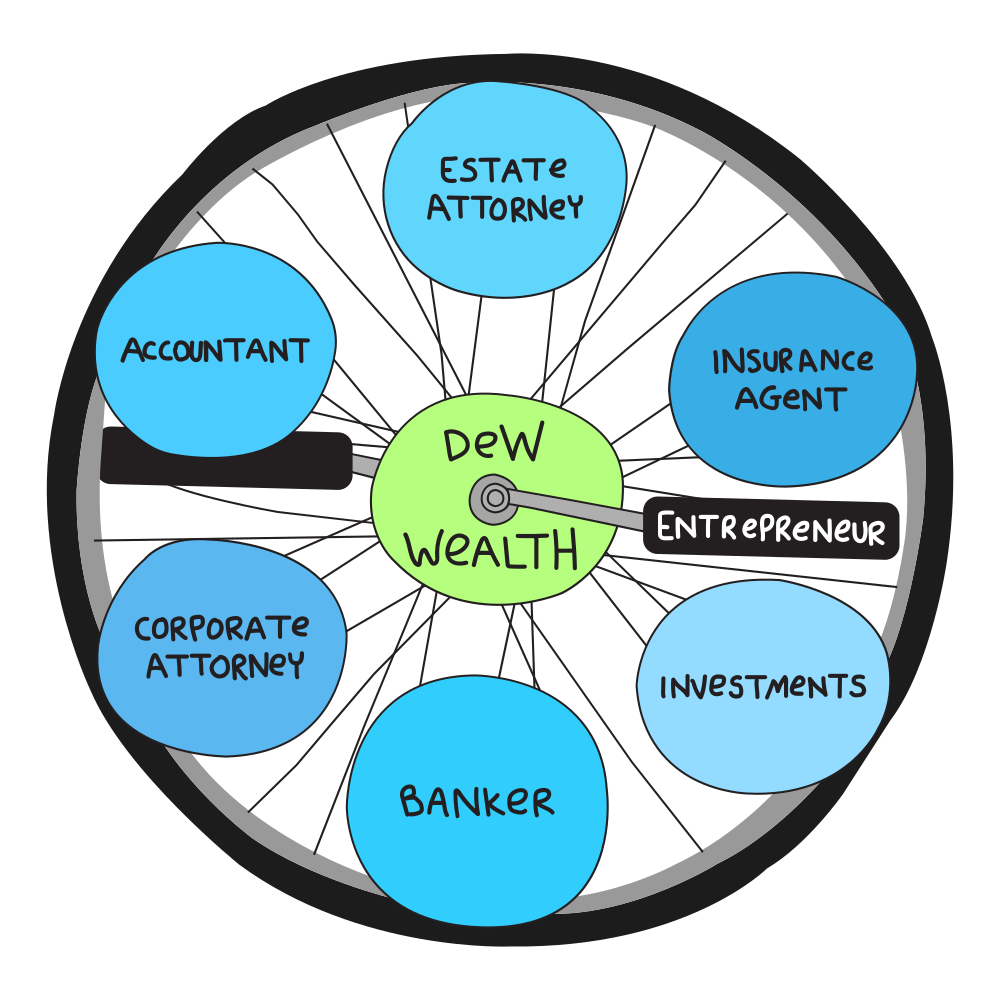
What Are the Components of the Wealth Wheel?
How Does Tax Planning Work Within the Wealth Wheel?
Tax planning within the Wealth Wheel is a proactive, year-round process that goes far beyond compliance filing. Most entrepreneurs view tax work as filing returns accurately and on time. The Wealth Wheel transforms the tax spoke into strategic tax management.
Tax advisors within the Wealth Wheel meet with the entrepreneur at least quarterly, focusing on opportunities under the Internal Revenue Code (IRC) rather than just compliance matters. Under the DEAPR framework, the tax spoke evaluates deferral strategies under IRC Sections 401(k) and 415 (including defined benefit plans, cash balance plans, and profit-sharing plans), elimination strategies under IRC Sections 1202 (QSBS exclusion) and 199A (QBI deduction of up to 20% on qualifying pass-through income), and arbitrage opportunities between entity types (S corporations under IRC Section 1362 vs. C corporations under IRC Section 11 at the flat 21% federal rate).
The tax spoke coordinates with the investment team on portfolio gains and tax-loss harvesting, with estate planners on trust income under IRC Section 641, and with business advisors on entity structure optimization. The IRS publishes updated rate tables, contribution limits (such as the $23,500 employee 401(k) deferral limit for 2025), and phase-out thresholds annually. Without this coordination, tax-saving opportunities are routinely missed.
Charitable giving strategies under IRC Section 170 should align with high-income years to maximize deduction value. Retirement plan contributions should be calibrated against both current income and projected future tax rates. Tax planning strategies involve trade-offs between current-year savings and long-term tax position. No strategy eliminates tax liability entirely.
How Does Estate Planning Function as a Wealth Wheel Spoke?
Estate planning within the Wealth Wheel creates a comprehensive strategy to protect and transfer wealth according to the entrepreneur's wishes. For business owners, estate planning means addressing complex issues like business succession, family governance, and multi-generational wealth preservation through the STEWARD Framework.
Under IRC Section 2001, the federal estate tax applies to estates exceeding $13.99 million per individual (2025 threshold, indexed for inflation by the IRS). The Tax Cuts and Jobs Act of 2017 (Public Law 115-97) doubled this exemption, but the increase is scheduled to sunset after December 31, 2025, potentially reverting to approximately $7 million (adjusted for inflation under IRC Section 2010(c)). IRS Treasury Regulation 20.2010-1(c) protects gifts made using the higher exemption from clawback after the sunset.
The estate spoke coordinates with the tax spoke to utilize available exemptions and gifting strategies, with the insurance spoke for estate liquidity planning (including Irrevocable Life Insurance Trusts to exclude death benefits from the insured's taxable estate under IRC Section 2042), and with the legal spoke for proper trust and entity structuring under the Uniform Trust Code (UTC) and state probate law.
Estate planning strategies carry implementation costs (attorney fees, trust administration fees, appraisal costs) and involve irreversible decisions in structures such as irrevocable trusts. Each strategy should be evaluated against the entrepreneur's specific goals, family circumstances, and risk tolerance.
How Does Insurance and Risk Management Prevent Coverage Gaps?
Insurance coverage within the Wealth Wheel extends across all entities and personal assets without gaps. The insurance spoke communicates with the legal team so that umbrella policies properly cover every entity (including LLCs, S corporations, and holding companies), and with the tax advisor so that policy structures are tax-efficient.
State insurance commissioners regulate policy terms, coverage minimums, and agent licensing within each jurisdiction. The National Association of Insurance Commissioners (NAIC) sets model standards, but requirements and consumer protections vary by state. Under IRC Section 2042, life insurance proceeds included in the insured's estate may be subject to estate tax if the insured held incidents of ownership in the policy.
The insurance spoke evaluates coverage across property and casualty, general liability, umbrella, cyber liability, Employment Practices Liability Insurance (EPLI), business interruption, life, disability, and key person policies. Each policy must be reviewed against the entity structures created by the legal spoke to prevent the coordination gaps that the ILATE framework identifies.
Insurance provides risk transfer, not risk elimination. Policy exclusions, coverage limits, and claims processes vary by carrier and state regulation. The Wealth Wheel ensures these policies are reviewed as a coordinated whole rather than purchased piecemeal by different professionals at different times.
How Does Investment Management Coordinate With Other Spokes?
Investment decisions within the Wealth Wheel account for business cash flow needs, the entrepreneur's tax situation under the IRC, and the overall wealth plan. The investment spoke coordinates with tax advisors to optimize after-tax returns through asset location and tax-loss harvesting, and with estate planners to ensure proper asset titling within trusts and entities.
Under the SEC Investment Advisers Act of 1940, registered investment advisors owe a fiduciary duty to clients. Under FINRA Rule 2111 and SEC Regulation Best Interest (Reg BI), recommendations must be suitable and in the client's best interest. The Wealth Wheel goes beyond these regulatory minimums by ensuring investment decisions are made with full visibility into the entrepreneur's tax situation, estate plan, and asset protection structure.
The Uniform Prudent Investor Act (UPIA), adopted by the majority of U.S. states, requires fiduciaries managing trust assets to diversify investments, consider the portfolio as a whole, and balance risk against return objectives. The investment spoke implements these requirements in coordination with the estate planning spoke to ensure trust investment policies align with distribution schedules and beneficiary needs.
Investment returns depend on market conditions, asset allocation, and economic factors. No investment strategy eliminates the risk of loss or predicts positive returns. Diversification does not eliminate market risk.
How Does Legal and Entity Structuring Provide the Protective Framework?
Legal structures designed in coordination with tax and insurance professionals prevent the costly gaps that arise from siloed advice. Entity structures (LLCs under the Revised Uniform Limited Liability Company Act, S corporations under IRC Section 1362, C corporations under IRC Section 11, partnerships under IRC Section 701) must be reviewed against insurance coverage, tax elections, and estate plans to ensure alignment.
Under the Revised Uniform Limited Liability Company Act (RULLCA) and state corporate statutes, entity formation requires compliance with specific formalities. Failure to maintain corporate formalities (separate accounts, annual filings, proper documentation) can result in courts piercing the corporate veil, eliminating the liability protection the entity was designed to provide.
The legal spoke coordinates with the tax spoke on entity elections, with the insurance spoke on coverage alignment (ensuring umbrella and liability policies name each entity), and with the estate spoke on entity ownership within trusts. Legal structuring involves formation costs, annual compliance requirements, and ongoing maintenance. Overly complex structures can create administrative burden disproportionate to the protection provided. The legal spoke works with the Linchpin Partner to ensure structures are appropriate for the entrepreneur's actual risk profile and wealth level.
What Role Does the Linchpin Partner Play in the Wealth Wheel?
The Linchpin Partner is the central figure who coordinates all components of the Wealth Wheel. The Linchpin Partner functions as a chief financial strategist for the entrepreneur's personal wealth: driving implementation, maintaining communication between all professionals, and ensuring that strategies are executed throughout the year rather than discussed once and forgotten.
Under the CFP Board's Standards of Conduct, Certified Financial Planner professionals must act as fiduciaries and consider the client's total financial situation. The Linchpin Partner operates under this standard, providing the coordination layer that no individual spoke can deliver independently.
The Linchpin Partner also serves as a quality control mechanism. When one spoke makes a recommendation, the Linchpin Partner evaluates the recommendation against the other spokes before implementation. This cross-spoke review prevents well-intentioned but uncoordinated advice from creating the costly gaps the Wealth Wheel is designed to eliminate.
The Linchpin Partner role involves advisory fees. The value of coordination must be evaluated against these costs, and the benefit typically scales with the complexity of the entrepreneur's financial picture and the number of professional relationships that require integration.
How Does the Wealth Wheel Work in Practice?
A software entrepreneur sold the entrepreneur's company for $12 million. The entrepreneur's investment advisor immediately invested $8 million in a diversified portfolio. Simultaneously, the entrepreneur's tax advisor was developing a strategy requiring $3 million in liquidity for a Qualified Opportunity Zone investment to defer significant capital gains under IRC Section 1400Z-2 within the 180-day investment deadline.
Without coordination, these two well-intentioned advisors created a situation where the entrepreneur either had to liquidate newly purchased investments (triggering transaction costs and short-term capital gains tax under IRC Section 1001) or miss the Qualified Opportunity Zone deadline. Uncoordinated professional advice resulted in approximately $430,000 in unnecessary taxes and costs because two advisors were not communicating.
A manufacturing business owner experienced a similar coordination gap. The business attorney set up entity structures (multiple LLCs under a holding company) while the insurance agent provided seemingly comprehensive coverage. Neither professional realized, due to lack of communication, that the umbrella policy did not extend over all the entities. When a major lawsuit hit an unprotected entity, the business owner paid over $700,000 out of pocket for a liability that should have been fully covered by insurance.
Both situations would have been prevented by a functioning Wealth Wheel with a Linchpin Partner coordinating all spokes. These examples illustrate common coordination failures, though individual outcomes depend on specific circumstances, the professionals involved, and the complexity of the financial structures.
When Should Entrepreneurs Implement the Wealth Wheel?
The Wealth Wheel applies to every entrepreneur with multiple professional advisors. The framework becomes most valuable once the complexity of coordinating tax strategies under the IRC, estate plans under state probate law, insurance coverage under state insurance codes, investment management under SEC and FINRA rules, and legal structures under state business law exceeds what the entrepreneur can manage alone. This complexity threshold typically occurs as annual income exceeds $500,000 or net worth exceeds $2 million.
Implementation starts with a gap analysis: mapping current advisors against the required spokes, identifying communication gaps between professionals, and evaluating whether individual advisors meet the quality standard for the respective discipline. The analysis may reveal that some advisors need to be upgraded, that missing spokes need to be added, or that an existing team simply needs a coordination layer.
Adding a Fractional Family Office® to serve as the hub provides the Linchpin Partner who drives the Wealth Wheel. The Family Office Exchange (FOX) reports that traditional single-family offices typically require $100 million or more in assets under management. The Fractional Family Office® model makes the coordination infrastructure of a traditional family office accessible to seven-figure and above entrepreneurs.
The Wealth Wheel requires ongoing maintenance, not a one-time setup. Quarterly coordination meetings, annual comprehensive reviews, and event-driven updates (business sales, legislative changes such as the Tax Cuts and Jobs Act sunset, family milestones) keep the Wealth Wheel functioning effectively. The Wealth Gap Diagnostic provides a structured tool for measuring coordination quality year over year. Results depend on the quality of the professionals in each spoke, the effectiveness of coordination, and the entrepreneur's engagement with the process.