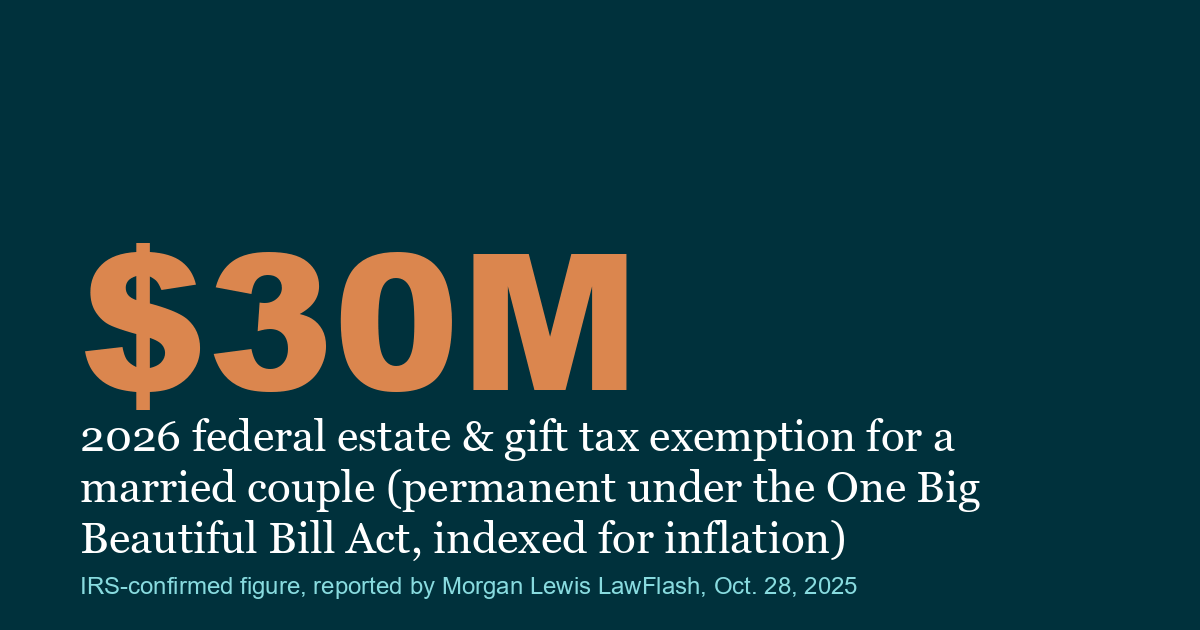
Estate planning for business owners usually starts too late. Most owners wait until they have a signed letter of intent to think about estate tax exposure, and by then the biggest opportunity is already gone. Under current law, a married couple can shield up to $30 million from federal estate and gift tax in 2026. That number only protects what a business is worth today. Locking in today's value inside an irrevocable trust, years before a sale, is what actually protects everything the business grows into after that.
What does estate planning for business owners actually mean before a sale?
Most owners treat estate planning as a document exercise: a will, a trust, a beneficiary form, updated every few years and otherwise ignored. For an owner sitting on a business that could be worth multiples of today's value at exit, estate planning is really a timing decision.
The IRS taxes an estate on everything above the exemption at a top federal rate of 40%. As of 2026, the exemption is $15 million per person, or $30 million for a married couple, and it is now permanent under the One Big Beautiful Bill Act rather than scheduled to shrink, though it still adjusts for inflation each year and Congress can change the law again at any time. Confirm the current figure with your CPA or estate planning attorney before relying on it.
The number that actually determines the tax bill isn't the exemption. It's the value the IRS uses to measure the estate, and when that value gets locked in.
What is a Spousal Lifetime Access Trust, and why does timing matter?
A Spousal Lifetime Access Trust, or SLAT, is an irrevocable trust one spouse funds for the benefit of the other spouse and, typically, their descendants. Once assets go into the trust, they are no longer part of either spouse's taxable estate, and the trust also adds a layer of creditor protection the assets did not have while held individually.
The mechanism only works if it happens before the growth it is meant to protect. Fund a SLAT with business equity while the company is valued at $8 million, and the trust locks in $8 million against the lifetime exemption. Every dollar the business grows in value after that, whether the eventual sale price is $20 million or $80 million, happens outside the taxable estate. Fund the same trust the month before a signed deal closes, and the IRS values the gift at or near the sale price, which uses up far more of the exemption while protecting very little of the growth that already happened. The tradeoff is control: once assets sit inside an irrevocable trust, the original owner cannot simply take them back, so this move only makes sense for value an owner is genuinely comfortable moving out of their own estate.
Why does funding a trust years before a sale work better than funding one after a term sheet?
Business owners who wait until a deal is in motion run into two problems. First, a professional valuation performed while a sale is actively being negotiated will reasonably reflect that pending transaction, which defeats the purpose of locking in a lower value. Second, the timing itself invites scrutiny: a gift made in the shadow of an imminent, already-negotiated sale is more likely to be challenged as having reflected the deal price all along.
Hypothetical example, not an actual client: say a business owner funds an irrevocable trust with equity valued at $8 million, four years before selling the company. If the business is worth $40 million at the time of sale, the $32 million of appreciation between the funding date and the sale is never included in the couple's taxable estate, because the trust already owns it. Fund that same trust the month before closing instead, and the full $40 million gets valued at or near the sale price, which both uses far more of the lifetime exemption and shields very little of the growth. Same trust, same business, four years of difference in outcome.
This is illustrative arithmetic only. Every situation depends on the business's actual valuation, the owner's full estate picture, and current law, and should be modeled with a CPA and estate planning attorney before any transfer is made.
What else should business owners plan for before an exit?
Estate planning is one piece of a larger timeline that starts well before a business goes to market. Deal paths rarely run in a straight line. A private equity buyer's proposed structure can fall through over financing terms. An employee stock ownership plan might get explored and set aside once the required debt load does not work for the business's cash flow. The transaction that does close often asks the owner and key leadership to roll part of their equity into the new ownership group rather than cashing out entirely.
Deal mechanics matter too. Representations and warranty insurance, when available, can reduce the escrow amount held back at closing, which means more cash in hand sooner rather than tied up for a year or two.
The same forward planning applies to what happens after the wire hits. Owners who think through how sale proceeds get diversified across real estate, cost segregation, other investment strategies, and charitable vehicles tend to get better after-tax outcomes when that plan exists before the closing date, not after, since some of those structures take time to set up properly and some depend on decisions made earlier in the sale process. See our broader tax planning resources for entrepreneurs for how these pieces fit together.
What should business owners do next?
The work that protects the most value in a business exit happens years before the business goes to market, not in the weeks after an offer arrives. That means coordinating the estate planning attorney, the CPA, and the wealth advisor around one timeline instead of reacting to each piece separately, which is exactly the kind of coordination a fractional family office for entrepreneurs is built to provide.
Dew Wealth Management works with entrepreneurs to build that kind of timeline into their legacy and wealth transfer planning long before a letter of intent shows up. If a sale is somewhere on your horizon, even a few years out, the estate planning conversation is worth having now.