Asset protection for business owners usually starts with the wrong threat. Entrepreneurs insure against the lawsuit, the creditor, and the accident, and then get blindsided by the person sitting across the table: a business partner. A partner dispute can reach ownership, control, and cash flow in ways an outside claim never can, and the defense is not an insurance policy. It is a set of governance documents put in place while everyone still gets along. Three of them do most of the work.
Why are partner disputes a bigger threat than outside lawsuits?
A partner dispute is more dangerous than most outside claims because the person on the other side already has legal standing inside the company. An outside plaintiff has to prove liability and then get past your entity structure and insurance to reach anything. A co-owner starts with rights to information, to distributions, to a vote, and sometimes to force a sale or a dissolution. When those rights are undefined, a disagreement over strategy or money can freeze decision-making, stall distributions, and put the value you spent years building into a courtroom.
The cost is not hypothetical. A contested partnership buyout commonly runs into the mid-six figures per side and takes a year or more to resolve, and the departing owner often cannot fund their side because the buyout is the money they were counting on. That is the real exposure: not a jury verdict, but a slow, expensive fight between people who used to trust each other. It is also the exposure most standard asset protection plans ignore.
What documents protect against a partner dispute?
Three documents carry most of the load, and they answer three different questions before anyone needs the answers. Each one is worth more the earlier it is signed, because you cannot negotiate fair terms with a partner you are already fighting.
The operating agreement (or shareholders' agreement) is the ownership rulebook. It defines capital contributions, how profits and losses are allocated, distribution policy, and what each owner is and is not entitled to. Most closely held companies have one, but a large share of them are generic templates that go silent exactly where a real dispute lives.
A decision-authority framework defines who decides what. It draws the line between the day-to-day calls one partner can make alone and the major moves (taking on debt, hiring or firing executives, selling assets, changing strategy) that require agreement. Without it, every significant decision is a potential standoff, and a 50/50 company with no tiebreaker is one disagreement away from deadlock.
Governance procedures set the formal process for the big decisions: how votes happen, what a quorum is, how meetings are called and documented, and how a deadlock gets broken. These are the same corporate formalities that keep your entity's liability shield intact, so they do double duty in a protection plan.
What is the one provision most agreements get wrong?
The buy-sell provision is the heart of partner-dispute protection, and it is the one that most often fails in practice. A buy-sell defines what happens to an owner's stake when someone exits, and a workable one answers four questions in advance: what triggers a buyout, how the interest is valued, how the purchase is funded, and how a disagreement about the number gets resolved.
The valuation method is where most agreements break. A fixed price set at formation goes stale almost immediately; a business worth $1 million at signing may be worth several times that a few years later, and the formula is still binding unless both owners agree to override it, which the one who benefits rarely will. A defined formula tied to earnings or revenue, or a requirement for an independent appraisal under a stated standard of value, holds up far better, provided the agreement says who selects the appraiser and how a dispute over the result is settled. The funding piece matters just as much: a buyout obligation with no cash behind it forces a loan or an asset sale at the worst possible moment. This is technical legal and valuation territory, so treat the framework here as education and work the specifics through a qualified attorney; it is not legal advice.
How do you plan for every way a partner can exit?
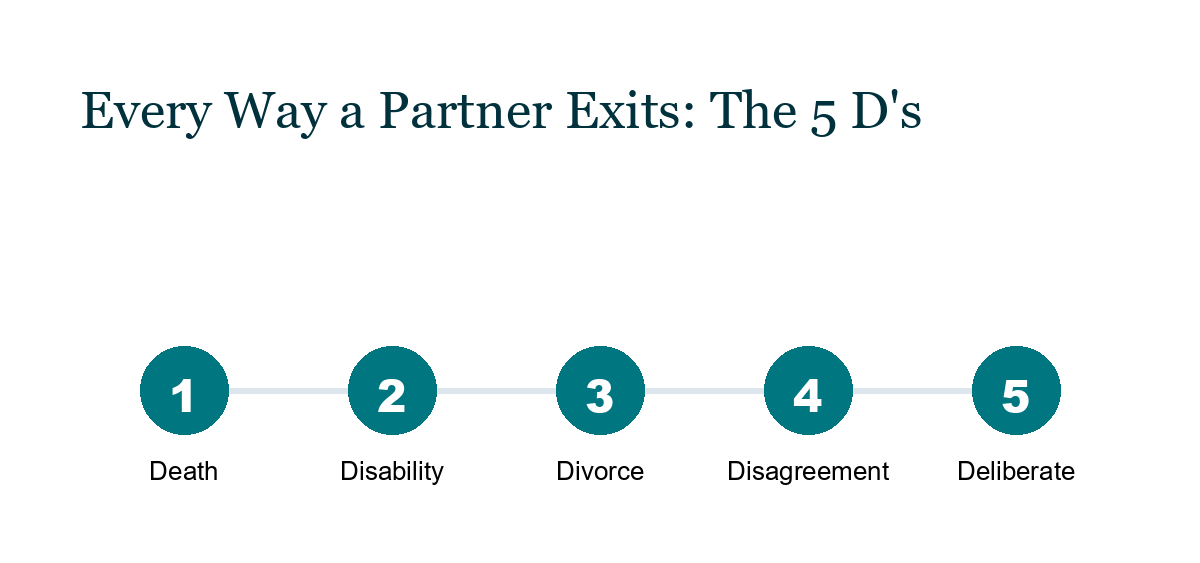
Partner separations happen through a predictable set of doors, and a complete buy-sell addresses each one. At Dew Wealth Management we describe them as the 5 D's of business transition: Death, Disability, Divorce, Disagreement, and Deliberate departure. Four of the five are involuntary, which is the whole argument for planning early.
| Trigger event | What the agreement should define |
|---|---|
| Death | Who buys the interest, at what value, funded how (life insurance is common); how heirs are handled |
| Disability | Definition of disability, waiting period, valuation, and a funded payment structure |
| Divorce | Restrictions preventing an ownership interest from passing to a former spouse |
| Disagreement (deadlock) | A resolution or tiebreaker mechanism, and a defined exit path if the deadlock holds |
| Deliberate departure | Right of first refusal, for-cause versus without-cause terms, and transfer restrictions |
An agreement that covers a voluntary sale but not deadlock, or death but not disability, leaves a gap exactly where a contested situation is most likely to start. The point of naming all five doors is to make sure none of them opens onto a fight.
Where does partner-dispute protection fit in the bigger picture?
Partner-dispute protection is one layer of a coordinated defense, not a standalone fix. Most entrepreneurs build asset protection in separate, disconnected layers: an attorney forms the entities, an insurance agent writes the policies, and no one is responsible for whether the pieces fit together. The gaps between those layers are where wealth leaks out. Your governance documents have to align with your entity structure, your insurance has to match your actual risk, and your buy-sell has to be funded and current.
Coordinating those pieces is a job, and it is the job most business owners are stuck doing themselves between advisors who do not talk to each other. The coordination advantage of a single point of accountability is what turns a stack of documents into an actual defense. That is the model behind the Fractional Family Office®: one team responsible for the whole picture, so the operating agreement, the buy-sell, the insurance, and the entity structure are built to work together. You can see how the pieces connect across the full asset protection framework.
The through-line is timing. You cannot draft a fair buy-sell with a partner you are already suing, the same way you cannot buy homeowner's insurance while the house is burning. The protection works because you built it while the relationship was healthy and no one had a reason to game the terms. If you have partners and your operating agreement is a template you barely read, that is the place to start, and to start before you need it.