The most common question after a sale is what to do with the money after selling your business. The short answer: treat the proceeds and the rest of your balance sheet as one plan, not a pile of cash to move quickly. For years, most of your net worth sat in a single private, illiquid asset. The work now is deliberate diversification matched to your actual goals, not a fast bet. All investing involves risk, including the possible loss of principal.
Why does a business sale change your whole financial picture?
Before the sale, your company was your largest position by far: concentrated, illiquid, and tied to your daily decisions. After the sale, that value converts to liquid capital, and your risk profile flips almost overnight. The question stops being how to grow one business and becomes how the whole balance sheet should look now. That is a different problem, and the instincts that built the company do not automatically answer it. Treating the two moments as one continuous plan is what keeps a good exit from turning into a poor investment outcome.
What is the risk paradox most business owners fall into?
Entrepreneurs take real, deliberate risk to build one company, then handle their outside capital in a way that quietly works against them. Some become overly cautious with everything outside the business, holding cash and low-return positions while inflation erodes them over time. Others do the opposite and roll the full proceeds straight into the next venture, staying just as concentrated as they were before. Both are accidental allocations, not chosen ones. The pattern is the same in each case: the wrong amount of risk ends up in the wrong place, for reasons that have more to do with habit than with a plan.
What should you do with the money after selling your business?
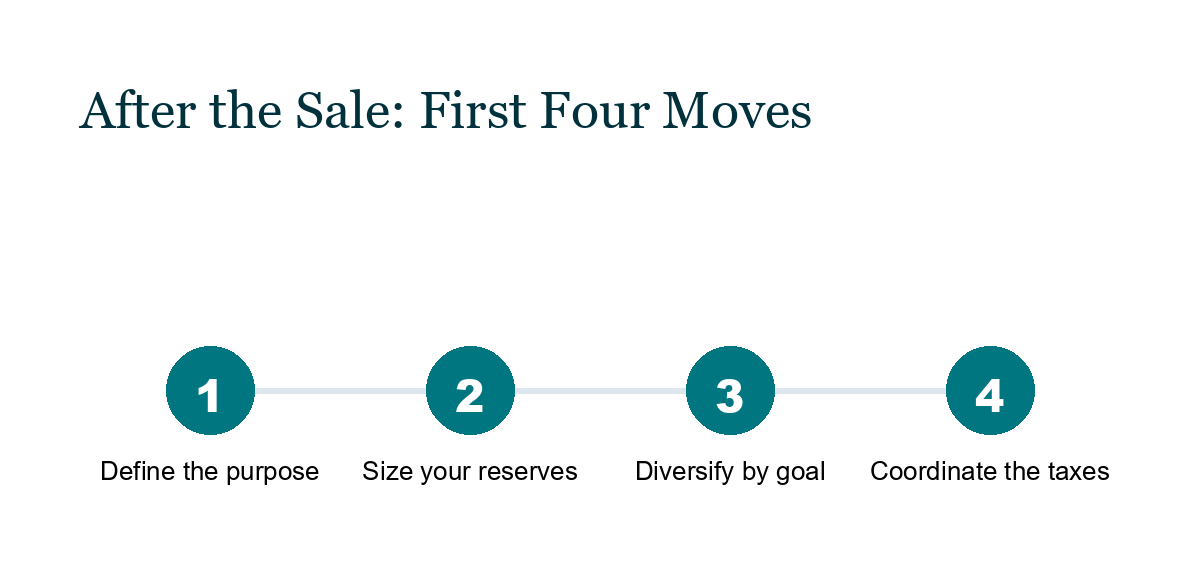
Start by treating this as a coordination problem, not a stock-picking one. Four questions come first, before any specific investment. What is the money actually for: income, long-term growth, giving, or funding what you do next? How much liquidity do you need on hand for the next few years? How should the rest diversify across asset classes given your goals and your tolerance for risk? And how does the tax outcome of the sale change the amount you actually have to invest? Answer those four, and the specific choices get far simpler.
How much risk is the right amount now?
There is no single correct number, and any honest answer depends on your situation rather than a formula. The inputs that matter are your time horizon, how much income you need the portfolio to produce, what you plan to do next, and how you actually react when markets fall. Diversification seeks to reduce the concentration risk you carried inside the business, spreading exposure so no single outcome dominates the result. It does not remove risk, and it is not a promise about returns. The point is to choose your risk on purpose instead of inheriting it by default.
How do taxes on the sale affect the investing decision?
The number you invest is the after-tax number, and the structure of the sale can move it materially. Whether the deal was an asset sale or a stock sale, whether part of it was structured as an installment sale, and whether any of the stock may qualify for the Qualified Small Business Stock exclusion can each change what actually lands in your account. Rules like these are technical and fact-specific, so confirm your own situation with a qualified tax professional before acting. Planning the tax outcome and the investment plan together, rather than one after the other, is where a lot of value is preserved.
Why does coordination matter more than any single investment?
When your investments, taxes, estate plan, and entity structure are handled by separate people who do not talk to each other, the allocation decision gets made with only part of the picture in view. A coordinated approach puts those pieces on one table. At Dew Wealth Management, the Fractional Family Office® model is built so one team sees the whole financial picture and acts on it, which is the difference between a set of disconnected accounts and an actual plan. The aim is a portfolio designed to reflect your life and goals, not one advisor's slice of them.
What does coordinated planning change after a sale?
The practical difference shows up in who sees what. Here is how the same set of decisions tends to play out under a fragmented setup versus a coordinated one.
| Decision | One advisor at a time | One coordinated team |
|---|---|---|
| Who sees the full balance sheet | Each advisor sees their own slice | One team sees investments, tax, estate, and entity together |
| How the sale's tax impact is handled | Often addressed after the fact, separately | Planned alongside the investment decision |
| How the allocation is decided | Product by product | Against your stated goals and liquidity needs |
| Who owns the overall plan | No single owner | A named point of coordination |
Selling a business is not the finish line for your wealth. It is the moment the game changes from building one asset to managing many. Deciding what to do with the proceeds is less about finding a perfect investment and more about building a plan that treats the whole picture as one. Get that part right, and the individual decisions tend to follow.