If your financial advisors don't talk to each other, you have what Dew Wealth Management calls a Financial Flat Tire. Every spoke is competent on its own: a good CPA, a good attorney, a good insurance advisor, a good banker. What's missing is anyone coordinating the whole wheel. The fix is not a better specialist. It is naming one point of accountability who sees your entire financial life and sequences the work between the people you already trust.
What Does It Mean When Your Financial Advisors Don't Talk to Each Other?
Picture an entrepreneur who has built something real. A CPA, an attorney, an insurance advisor, and a banker are each doing solid work inside their own lane. None of them has ever been on a call together. The entity and trust structure has grown more complicated than any single one of them is actively tracking. Tax strategy gets set without reference to the investment account. Insurance coverage gets purchased without reference to the estate plan. Nothing about any one decision is wrong. The decisions were just never checked against each other.
That pattern has a name. Dew Wealth Management calls it the Uncoordinated Advisors Problem: a full team of capable professionals, each optimizing for their own discipline, with no one owning how the pieces fit together. It rarely looks like a crisis while it is happening. It looks like a normal Tuesday, four separate relationships, four separate calendars, and an entrepreneur relaying context between all of them because nobody else has the full picture.
What's the Difference Between Having Several Advisors and Having a Coordinated Team?
Having several advisors means each discipline is covered. Having a coordinated team means someone is responsible for how those disciplines fit together, on a schedule, with a written record of what was decided and why. Those are not the same thing, and most entrepreneurs have the first without the second.
Separate specialists tend to work reactively: each recommendation gets implemented as soon as it is ready, and conflicts surface after the fact, often on a return or at a claim. A coordinated team works on a cadence: recommendations get checked against each other before they are implemented, not after. The specialists do not change in either arrangement. What changes is who is accountable for the space between them, and when a conflict gets caught.
Why Does Advisor Fragmentation Cost You Even When Every Advisor Is Good?
Because competence and coordination are two different jobs, and most advisory relationships are built to deliver only the first one. A CPA is measured on the return. An investment advisor is measured on the portfolio. An insurance advisor is measured on the policy. None of them is measured on whether their work still holds up next to what the other three are doing.
That is why fragmentation tends to surface at the worst possible moment: a filed return, an insurance claim, a term sheet on a sale. By the time the conflict shows up, the decision that created it was usually made months or years earlier, by someone with no reason to check in with anyone else. The entrepreneur is the only person in the relationship who touches every discipline, and typically the only one not being paid to coordinate them.
What Does a Coordinated Model Actually Do Differently?
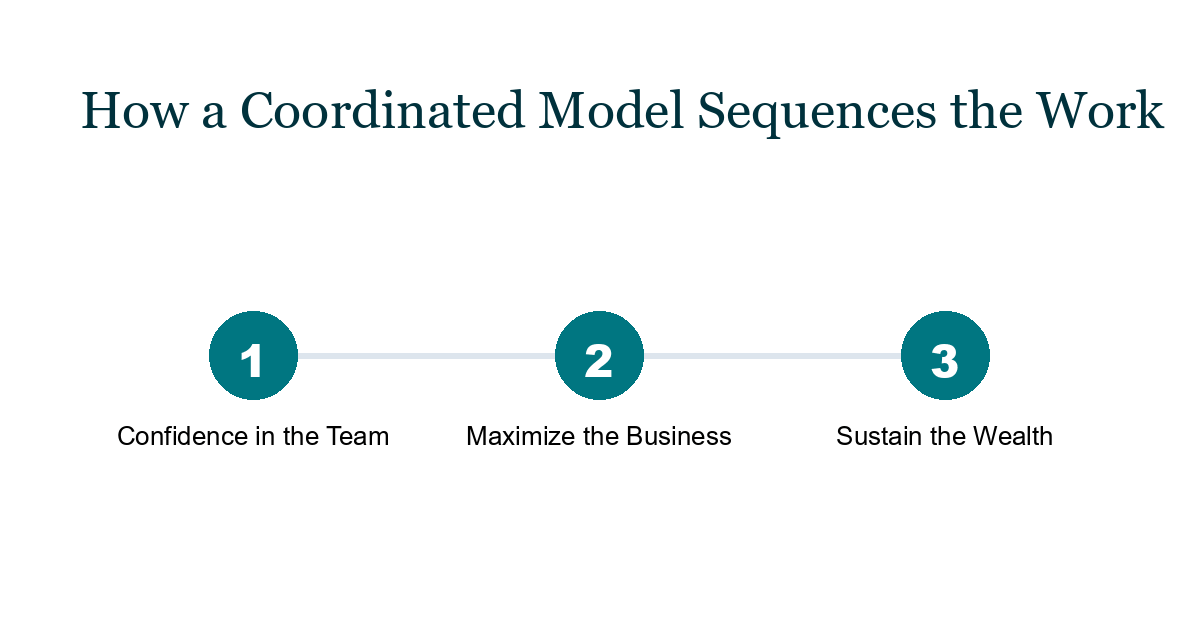
A coordinated model puts one team, and one point of accountability, ahead of everything else. In practice that plays out in a specific order.
First, build confidence in the team itself: every professional working from the same information, accountable to one coordinating point rather than operating on their own island. Second, maximize the wealth being generated inside the operating business, since that is usually where most of an entrepreneur's net worth actually lives. Third, sustain and protect the wealth once it has been harvested out of the business into investments, real estate, and other outside assets.
This is the same logic behind what Dew Wealth calls the Wealth Wheel: a financial life is made of several interconnected dimensions, not one. A business owner can be excellent at investing and still be exposed on entity structure, insurance, or succession. A wheel with one strong spoke and six weak ones still wobbles, no matter how strong that one spoke is.
Who Should Coordinate My Financial Advisors?
Someone with three specific qualities, and a fee structure that does not quietly work against the answer. Dew Wealth calls this role the Linchpin Partner®: a fiduciary at all times rather than situationally, experienced enough to have been through a real downturn or a real exit, and positioned to anticipate problems before they surface rather than react once they have.
Standing matters as much as title. The coordinator needs enough credibility with the CPA, the attorney, and the insurance advisor that a joint call actually happens, and enough independence that the coordination itself does not quietly steer decisions toward whichever advisor gets paid the most. A fixed-fee, fiduciary relationship is built for that role in a way a commission or an assets-under-management fee is not, because the coordinator's compensation does not move based on which advisor's recommendation wins.
Bryce Keffeler, Managing Partner at Dew Wealth Management and co-author of Billionaire Wealth Strategies for Entrepreneurs: The Fractional Family Office, puts it plainly with the entrepreneurs he works with: the goal is not to add a fifth advisor to the pile. It is to make the other four work as one team instead of four separate ones.
A Fractional Family Office® is one way to install that coordinating layer without needing the net worth or the internal staff a traditional single-family office requires. Whether that is the right structure for a given entrepreneur or not, the diagnostic question comes first: is your team actually coordinated, or just co-located on your calendar?